Platform
One configurable product, on one record.
The same core whether you represent the case or decide it — government or commercial; it ships in two editions, Counsel (for firms) and Docket (for adjudicating bodies). A small object model — a case and everything attached to it — with the Reader, an AI layer, Authoring, the Docket work engine, Sessions, and Reporting all reading and writing one record. Configuration, not a per-customer build, makes it your operation.
01Reader
The reader your team relies on every day.
A case's entire file — hundreds of documents, thousands of pages — opened as one ordered, searchable record.
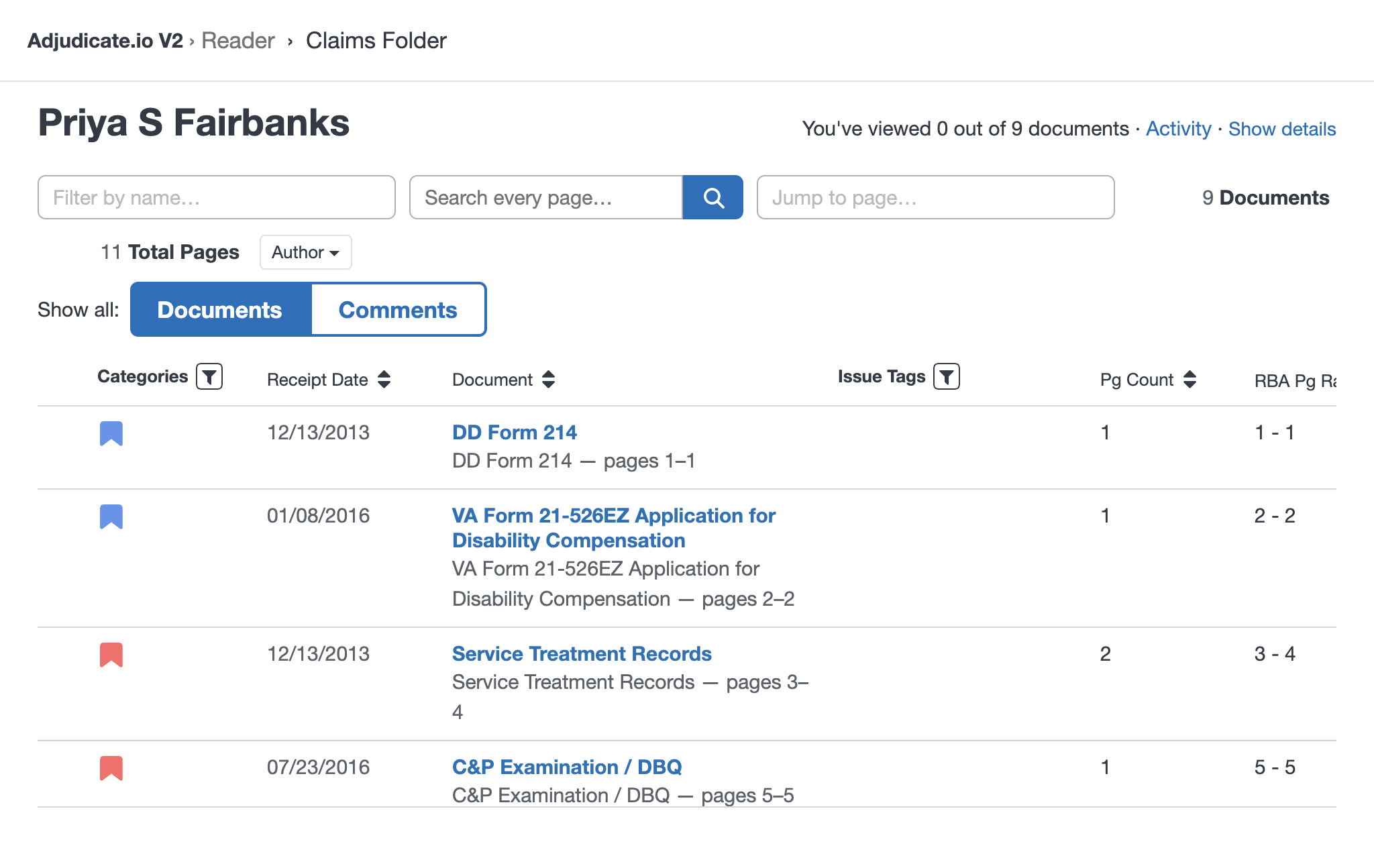
Shown on a fully synthetic claims file — no real veteran data.
Open the whole file, instantly.
Hundreds to thousands of documents per case, opened with no wait — any document on screen in under a second.
Find any document.
Search every page; sort and filter by receipt date, document type, or party. Results land on the exact page.
Know what you're looking at.
Issues, exhibits, parties, and receipt dates are how the record is organized. Not labels bolted onto a PDF.
Work the evidence.
Annotate, highlight, and cross-reference in place — your notes stay with the record, anchored to the page.
02AI
AI that suggests — never decides.
A layer over the whole record. Every output is a suggestion a reviewer accepts, edits, or rejects — and every one is an auditable record, grounded in the page it came from. Self-hostable, and built for messy records — gigabyte files and OCR noise.
Consolidate the issues.
Reads the file and pulls every adjudicated issue into one unified list, each with the evidence behind it.
Flag what's relevant.
Surfaces the documents and pages that matter most for an issue, so a large file opens to what counts.
Generate the work.
Scans new filings, identifies actionable ones, and suggests the tasks each requires.
Group related records.
Associates attachments and supplements with their submission as a single logical record.
03Authoring
Compose the decision from the evidence behind it.
A brief, a determination, a decision. Built from the issue list and the evidence that resolves it. Compose it here, or bind the editor you already use.
Tied to the evidence.
The issue list is the outline; every citation resolves to the exact page it came from, so the work product stays anchored to the record.
Reusable boilerplate.
A shared language library authors pull from — update a passage once and it reaches everyone who relies on it.
Sign and route.
An authorized signer fixes the document and its issue dispositions as the outcome; the Docket routes it onward.
04Docket
From a raw file to organized, assigned work.
The work engine — one engine runs the operation around the work, a firm's caseload or an adjudicating body's docket — configured, not forked.
- 01
Bring in a case.
Accept an unlabeled PDF or an upstream feed; auto-segment into typed, dated documents.
- 02
Catch duplicates.
Match identical submissions arriving by portal, fax, and mail in seconds — and surface the differences.
- 03
Route by rule.
Auto-distribute work with tunable levers — batch size, wait thresholds, priority — testable before they apply.
- 04
Work the queue.
A per-user assigned-work view; status updates as work is opened; search and filter within the queue.
- 05
Manage each case.
View and edit details, add notes, run motions and quality review — several people on one case at once.
05Sessions
Schedule it, hold it, keep the record.
Schedule without conflicts.
Suggest conflict-free slots across people and places, prevent double-booking, and build a day's docket from criteria.
Hold it anywhere.
In person, by video, or by phone — on a conferencing service the platform provides or binds to.
The record, not a side file.
Audio and a transcript land on the case as searchable documents — citable like any other evidence.
06Reporting
See the whole operation — live.
Because state and the full history are one queryable record, you read the operation as it runs — not from a weekly export to a separate tool.
Live, not nightly.
Real-time dashboards on throughput, queues, dwell time, and workload; ad-hoc queries, and export to the BI tool you already use.
Quality, in one place.
Score work product along the factors you define, and see complexity and quality per reviewer — on the record, not a spreadsheet on the side.
Trace any decision.
An append-only trail at the document and page level — who saw what, when, and what they did with it.
07One record
One configurable product, on one record.
The same core whether you represent the case or decide it — government or commercial. Record, Connect, Access, and Admin are the foundation every subsystem above reads and writes.
Record
Documents, issues, work, sessions, decisions, and audit all hang off a single case-partitioned, append-only record — searchable, exportable, retained, isolated by design.
Connect
Bind each edge — document source, identity, scheduling, output, notifications, reporting — to a system you already run, or let the platform provide it. A typed REST/SDK API drives both live integration and bulk migration off a prior system.
Access
Roles mapped to capabilities and record-level access control, enforced at every read and write; identity you integrate or the platform provides.
Admin
Case types, roles, workflows, queues, rules, and boilerplate are settings an administrator changes — not a developer release. Every customer runs the same product.
See the whole platform on a real case file.
A working product, in production today. Ask for a walkthrough.
Request a demo